Aug 13, 2026Product Introductions
Pelvic Floor Exercises with a Massage Ball: 5 Moves That Actually Work
Struggling with pelvic floor weakness? These 5 massage ball exercises are gentle, effective, and easy to do at home. No gym required.
If you've ever dealt with lower back tension, poor posture, or postpartum recovery, your pelvic floor is probably involved — and most people ignore it until it becomes a problem. The good news: you don't need expensive equipment or a physical therapist to start fixing it. A small massage ball is one of the most underrated tools for pelvic floor release and activation. It's portable, affordable, and precise enough to target the muscles other tools miss. In this guide, you'll learn exactly how to use a massage ball for pelvic floor work, what to avoid, and how to build a simple routine you can do in 10 minutes.
What Is the Pelvic Floor (And Why It Matters)
Your pelvic floor is a group of muscles that runs like a hammock from your pubic bone to your tailbone. It supports your bladder, bowel, and — for women — the uterus. When these muscles are too tight, too weak, or simply not coordinating with your breath, you feel it everywhere: lower back, hips, core, even your knees. Common signs of pelvic floor dysfunction:
- Lower back or hip pain that doesn't improve with stretching
- Difficulty activating your core during workouts
- Tension that gets worse after sitting for long periods
- Postpartum discomfort or diastasis recti recovery
Most people think pelvic floor exercises are just "Kegels." They're not. Sometimes the problem isn't weakness — it's tension. And tension responds better to release work than to squeezing harder.
Why a Massage Ball Works Better Than Foam Rolling
A foam roller is too broad for the pelvic floor. A massage ball — especially a small, firm one around 2.5 to 3 inches — gives you the precision to target the muscles around your hips, glutes, and lower abdomen without pressing directly on bone.
The key is indirect pressure. You don't roll directly on the pelvic floor muscles (which are internal). Instead, you release the surrounding muscles — glutes, hip flexors, adductors, and lower back — that pull on the pelvic floor and keep it tight.
Before You Start: Setup Tips
- Use a small, firm massage ball. A soft ball won't give you enough pressure. A lacrosse-style ball or a dedicated myofascial release massage ball works best.
- Breathe through your nose. Never hold your breath during release work.
- Stay on soft tissue, not bone. If you feel sharp pain on bone, move the ball.
- Wear comfortable clothing that doesn't restrict hip movement.
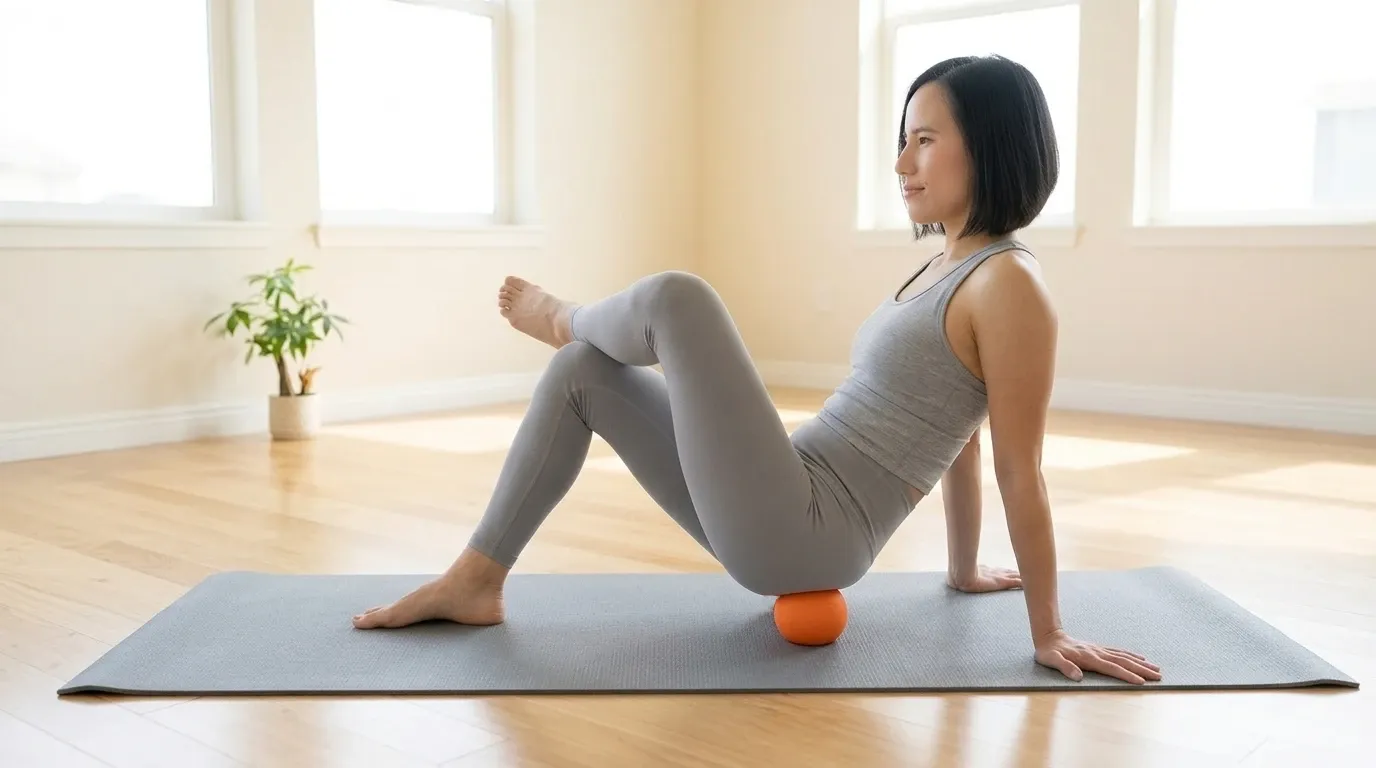
Exercise 1: Glute Release (Piriformis)
Targets: Deep glute muscles that connect directly to the pelvic floor. How to do it:
- Sit on the floor with your knees bent and feet flat.
- Place the massage ball under your right glute, slightly toward the outer edge.
- Cross your right ankle over your left knee (figure-four position).
- Slowly roll in small circles, pausing on any tight spot for 20–30 seconds.
- Breathe deeply. You should feel a dull, releasing ache — not sharp pain.
- Switch sides. Spend 90 seconds per side.
Why it works: The piriformis runs directly under the glute and attaches to the sacrum. When it's tight, it pulls on the pelvic floor and creates a chain reaction of tension up your lower back.
Exercise 2: Hip Flexor Release
Targets: Psoas and iliacus — hip flexors that tighten from sitting and restrict pelvic floor movement. How to do it:
- Lie face down on the floor.
- Place the massage ball just inside your front hip bone (about 2 inches to the side of your belly button, lower down).
- Rest your forehead on your hands and relax your body weight onto the ball.
- Hold for 60–90 seconds. Don't roll aggressively — this area responds better to sustained pressure.
- Switch sides.
Why it works: Your psoas connects your spine to your femur and passes directly in front of your pelvic organs. A tight psoas tilts your pelvis forward and keeps the pelvic floor in a constant state of tension.
Exercise 3: Adductor Release (Inner Thigh)
Targets: Inner thigh muscles that support pelvic floor stability. How to do it:
- Lie on your back with knees bent and feet flat.
- Place the massage ball on the floor and rest your inner thigh on it, about halfway between your knee and groin.
- Let your leg relax outward so gravity presses the muscle into the ball.
- Gently bend and straighten your knee to create a slow rolling motion.
- Spend 60 seconds per leg.
Why it works: The adductors share fascial connections with the pelvic floor. Releasing them improves hip mobility and reduces the downward pull on the pelvic floor during walking and standing.
Exercise 4: Lower Back Release (QL and Erector Spinae)
Targets: Lower back muscles that compensate for pelvic floor weakness. How to do it:
- Lie on your back with knees bent.
- Place the massage ball under your lower back, to one side of your spine (not on the spine itself).
- Lift your hips slightly and roll the ball up and down between your rib cage and pelvis.
- Pause on tight spots for 20–30 seconds.
- Do both sides, 90 seconds each.
Why it works: When your pelvic floor isn't engaging properly, your lower back muscles pick up the slack. Releasing them breaks the compensation pattern and lets your core work the way it's supposed to.
Exercise 5: Diaphragm Breathing with Ball on Abdomen
Targets: Core-pelvic floor coordination.How to do it:
- Lie on your back with knees bent.
- Place the massage ball on your lower abdomen, just below your belly button.
- Rest your hands on the ball.
- Breathe in through your nose for 4 seconds, letting your belly rise and push the ball upward.
- Breathe out for 6 seconds, feeling your belly fall and the pelvic floor gently lift.
- Repeat for 10 breaths.
Why it works: This isn't a "release" exercise — it's a re-education drill. The ball gives you tactile feedback so you can feel whether you're actually breathing with your diaphragm or just lifting your chest. Proper diaphragm breathing is the foundation of pelvic floor recovery.
How Often Should You Do This Routine?
Table
Goal | Frequency | Duration |
|---|---|---|
General maintenance | 2x per week | 10 minutes |
Postpartum recovery | 3–4x per week | 10–15 minutes |
Chronic hip/lower back tension | Daily | 10 minutes |
Consistency matters more than intensity. Ten minutes, three times a week, will produce better results than one 45-minute session.
Common Mistakes to Avoid
Rolling too fast. Release work requires sustained pressure. If you're rolling like you're trying to flatten dough, you're not giving the muscle time to relax.Pressing directly on bone. The massage ball belongs on soft tissue. If you feel bone, move the ball half an inch.Holding your breath. This creates more tension. If you catch yourself holding your breath, stop and reset.Expecting instant results. Pelvic floor recovery is gradual. Most people notice a difference after 2–3 weeks of consistent work.
When to See a Professional
A massage ball routine helps most people with mild to moderate pelvic floor tension. But if you experience any of the following, consult a pelvic floor physical therapist:
- Numbness or tingling in the groin or legs
- Severe pain during exercise
- Urinary incontinence that doesn't improve
- Pain during intercourse (for women) that persists beyond 6 weeks postpartum
The Right Tool for the Job
Not every massage ball is suitable for pelvic floor work. You need one that's:
- Small enough to target specific muscles (2.5–3 inches)
- Firm enough to create real release pressure
- Textured or smooth depending on your sensitivity
Ready to start? Our myofascial release massage balls are sized specifically for deep tissue work around the hips, glutes, and lower back — exactly what pelvic floor release demands.
Quick Reference: Your 10-Minute Routine
Table
Exercise | Time |
|---|---|
Glute Release (both sides) | 3 minutes |
Hip Flexor Release (both sides) | 3 minutes |
Adductor Release (both sides) | 2 minutes |
Lower Back Release (both sides) | 3 minutes |
Diaphragm Breathing | 2 minutes |
Total: ~13 minutes. Do this 3x per week for the next month and track how your lower back, hips, and core feel.
Have questions about pelvic floor recovery or massage ball techniques? Drop a comment below or reach out through our contact page.